
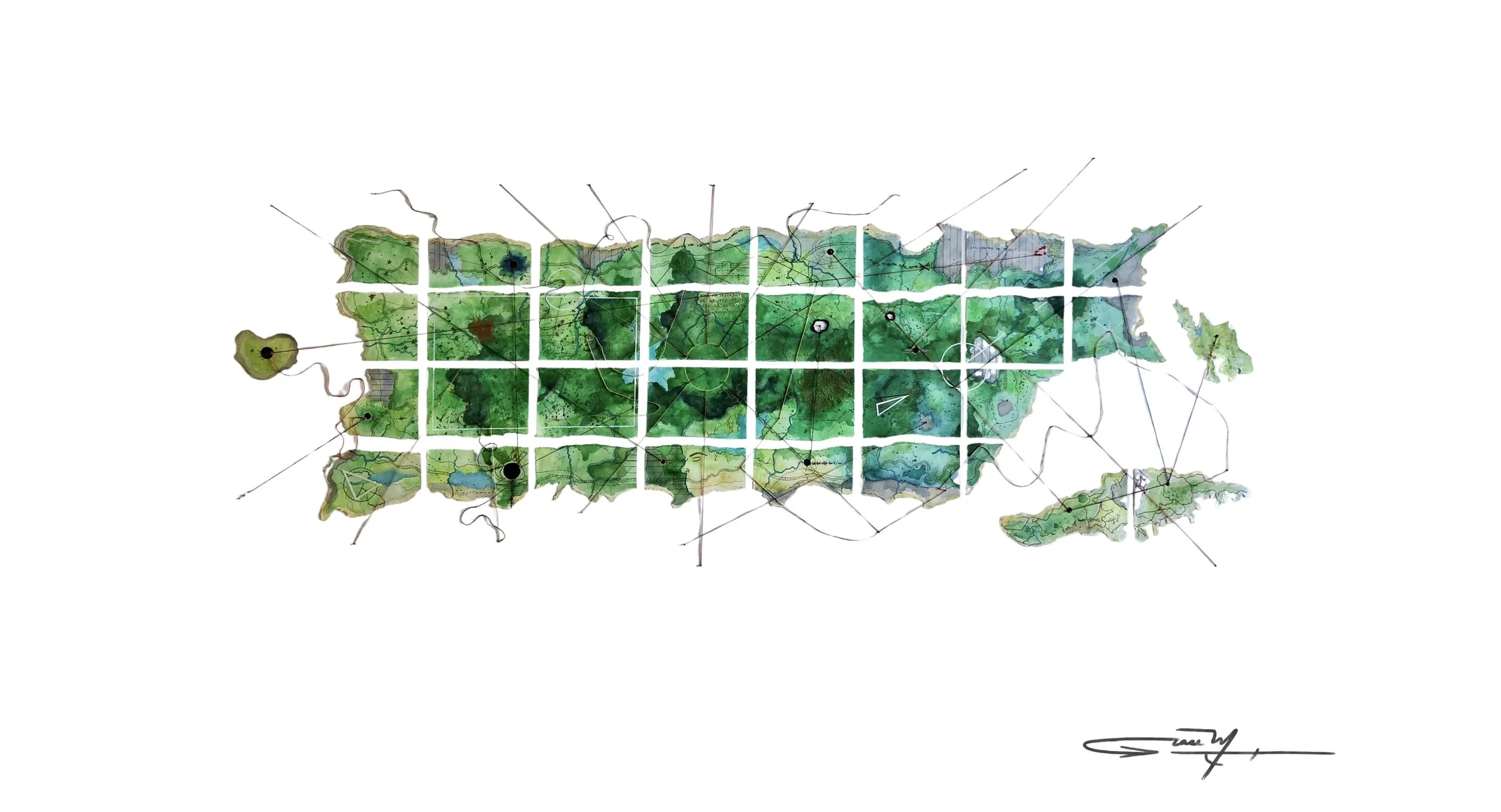
ArchiπELA Go. 2016. Polyptych mixed media: cotton threads, organic materials, ink, map pencils, watercolor: foraged sediment pigments in arabic gum on cotton paper. 243.84 cm x 121.92 cm. Private Collection. (designed, produced, framed, and sold by the artist on her penultimate year of BFA thesis collection of works.)
In the beginning, it had not announced itself as an argument.
The problem:
100 × 35 has arrived quietly into the collective unconscious. Disguised as something untraceable, so stupid, so ordinary, that later on, she could not believe its collapse had begun near the stairs.
“Why are you talking to me like that?” Lynceus asked.
She didn’t look up. The stove hissed like a witness.
“Like what?”
“That. Exactly that. You hear yourself?”
She turned the heat down. The kitchen steamed in its own damp, inhaled the heavy smell of his well-done version of tenderness.
“Lynceus, I’m cooking.”
He laughed—a dry sound, a hinge creaking.
“You hear yourself? This… this is what I mean.”
The unit breathed out—a subtle change, but final. The lights dimmed with shame. The walls bent closer, listening. Hunger took the moment into itself and spat it out again — larger now, uglier, no longer entirely theirs. It had always done that. It magnified the triviality of the common days, converting spoons into weapons, offhand tones to accusations. Twenty years of his life had soaked into the lopsided floorboards until man and structure were indistinguishable. Love, of course, is a disastrous inspector. It calls rot patina. It mistakes imbalance for intimacy. It looks at a sinking floor and says, "Maybe we can fix this“. But tenderness cannot level a floor.
She became a scholar of distortion—reading the pauses, the angles of his body, the pitch of his laugh. The kitchen transformed into a chamber of fragile incubation and vigilance, forcing ordinary objects to learn to remember against their will. When the day of the rupture finally came, the apartment had already been staged as a battlefield. The stove, the counters, the bad lighting—each knew its role.
Law would later flatten the mess into the most refined vocabulary: incident, statement, arrest, order of protection, not within the exquisite limits of language at all. Frigid words that traveled easily on paper, stripped of heat and smell, leaving behind the weight of rooms that swallowed their voices…
[——————————-noices———————————]
…and still, she woke early on June 5, 2026, and rode her bike to Rye Town Court. She arrived not as a file but as a body with legs, breath, sweat, and the muted fury of a woman who has been denied for her apparent simplicity. The courtroom tilted—not with cracked floors but with moral geometry. A face she expected was not the one she met. A promise wavered. A door stood open, but her body doubted its reach. In a Page, disappearance—she learned—is not always about absence. It can happen in full daylight under the roof of the State. Yet she returned and spoke. Undermined by her erasure interrupted, her magnetic field began to shift.
Not as a triumph.
Not with closure.
Relief.
A whisper carried within the perimeter of these walls recalls: I am here. I am.
It began with something else. Something stupid. Something so ordinary that later on, she would remain perplexed about remembering it all.
“Why are you talking to me like that?” Lynceus said.
She kept her eyes on the stove.
Fixed on the only thing that knew how to be consumed without pretending it is love.
Fire had rules.
Blood did not.
Grace Matos
Independent Art Researcher
•
A creative-non-fiction-gift-story for my person.
•
© [(1992)(2026)+(Present)x(Future)] Grace S. Matos García / Grace Portal/ _graceportal. Images, writing and editing held with care. All rights reserved.
