Saving Grace: The Architecture of Interior Sovereignty
Silver light rises through the Bernadotte Library of Stockholm's Kungliga Slottet, undisturbed, as though the room has been waiting centuries for this exact moment. Filtered through monumental panels of glass, it crosses a room constructed to communicate permanence: gilded ornaments, historical portraiture, exposed oak, ceremonial symmetry. The architecture announces itself before any individual within it has an opportunity to speak. It is a space in which authority has already been designed.
Near the head of the long table sits a Puerto Rican woman. She is neither monarch nor diplomat. She possesses no institutional title capable of explaining her placement there. Her presence therefore produces an immediate visual contradiction: she appears to occupy a position whose legitimacy architecture would ordinarily be expected to confer, yet nothing in her posture suggests that she is waiting for permission to occupy it.
Her dark hair has been gathered into a precise, low knot. She wears a charcoal-grey coat, single-breasted and unadorned, its restrained geometry refusing competition with the decorative excess surrounding her. The fabric absorbs rather than reflects the ambient light. Against the cold gold, marble, and historical ornamentation of the palace, the warmth of her olive skin becomes unusually perceptible. Her hands rest lightly upon the polished surface of the table, empty of documents, notes, or argument. There is no visible urgency. The figure remains almost unnervingly still. This stillness is the central action of the work.
Within a culture in which power is frequently represented through expansion — territory accumulated, voices amplified, monuments enlarged, bodies elevated above other bodies — the seated woman performs another conception of sovereignty entirely. She does not dominate the room. She does not need to. Instead, she establishes an internal perimeter that the room cannot penetrate.
I call this figure The Anchor.
The Anchor is not conceived as a portrait in the conventional autobiographical sense. She is an idealized psychological persona: a projection of the self after reactivity has relinquished its claim to governance. She represents neither emotional numbness nor withdrawal from reality. Her stillness is instead the consequence of containment. Anger remains historically possible. Desire remains biologically present. Memory remains active. Yet none possesses unilateral authority over the body.
Through a loosely Freudian architecture, the scene can be read as a negotiation among instinct, prohibition, and deliberation. The long mahogany table functions as an image of psychic structure — a place at which competing demands may theoretically be brought into relation, evoking the judgment, law, sequencing, and consequence traditionally associated with the superego. But the condition presented here is not the triumph of the superego over the id; such a victory would simply replace one tyranny with another. The id has not been destroyed. It has been deprived of executive power.
There is no scream because the scream is no longer required to establish existence. There is no impulsive gesture because urgency has ceased to function as evidence of truth. The primitive demand — act [now], strike [now], escape [now], desire [now] — remains part of the human organism, but it has lost its authority to determine what happens next.
The silence surrounding the woman is not emptiness. It is newly available cognitive territory — the interval between stimulus and response. That interval is where sovereignty begins. If the palace represents inherited structures of authority, the woman represents authority produced through self-regulation, and the distinction destabilizes the hierarchy of the image. Architecturally, everything suggests the Royal Palace should be the most powerful entity in the frame: its ceilings higher than the human body, its materials older than the woman, its history exceeding the duration of her life, its decorative vocabulary belonging to systems of monarchy, diplomacy, genealogy, patrimony, and statecraft that existed long before her arrival. Yet visually, the palace becomes secondary. The woman does not acquire significance because she has entered an important room. The room becomes conceptually useful because she has entered it.
The historical palace may command obedience through scale, provenance, wealth, and institutional memory, but The Anchor commands nothing. Her authority is precisely the absence of the demand to command. She neither petitions the institution nor rebels theatrically against it. She simply occupies a chair near the head of its table with the composure of someone who has ceased to confuse external recognition with ontological permission.The work is consequently concerned with the politics of placement.
What happens when a Puerto Rican female body is inserted into an architectural vocabulary historically designed to visualize European hereditary authority?
Her presence inevitably carries geographical and historical displacement — Puerto Rico exists within a radically different history of sovereignty, empire, citizenship, language, and cultural inheritance than the Swedish monarchy represented by the palace. The figure does not need to illustrate this history explicitly for the tension to operate. Her body already interrupts the visual continuity of the room. But I am not interested in staging her as an intruder. To describe her merely as someone who "does not belong" would preserve the palace's authority to determine belonging in the first place. Instead, the image asks a more difficult question:
Who granted architecture the authority to decide which bodies appear natural within it?
The Anchor refuses the premise. She does not assimilate herself into the room, nor does she perform cultural difference for its spectators. Her clothing is intentionally contemporary and restrained — no folkloric shorthand identifying Puerto Ricanness, no decorative symbolism functioning as anthropological proof. Her identity resides in the body rather than in costume.
This visual restraint matters because the work is not about gaining admission into European authority. It is about rendering such admission psychologically irrelevant. She has already arrived somewhere more consequential. She has arrived at herself.
The table consequently undergoes a second transformation. What first appeared to represent the superego — the externalization of order, judgment, and restraint — gradually becomes something closer to a negotiating chamber of consciousness. The woman is seated not before judges but before the accumulated versions of herself: instinctive self, injured self, desirous self, frightened self, intellectual self, historical self, imagined future self. Each could occupy a chair. None occupies the throne.
The sovereign consciousness is therefore not the loudest participant at the table but the faculty capable of hearing all of them without becoming identical to any one of them. Her hands remain empty because there is nothing to prosecute, nothing to prove. She is not producing a defense of her life. The image concerns the moment after defense.
Outside the palace, the waters of the Strömmen continue moving around the coast — a useful counterpoint to the figure's stillness. Water, does not cease because she has recomposed herself. History, does not cease because she arrived at the Palace. Society, does not cease because she made possible the Independence of Puerto Rico. Other people do not suddenly become reasonable but the external world, limits its speed due to the eighty kilometers of the archipelago's density that protects this woman from being assaulted.
Her transformutation occurs elsewhere:
Location: 51.2232° N 4.4073° E
However, the conservation of her beauty takes us back to The Library:
The body no longer interprets every movement around it as an instruction. This is perhaps the deepest meaning of The Anchor. An anchor does not stop the ocean. It establishes a relationship to movement in which movement no longer determines position. The metaphor also prevents stillness from being confused with passivity. An anchored vessel remains surrounded by forces — current, weather, gravity, tide — but possesses a mechanism through which it can resist being carried indiscriminately by them. Likewise, psychological sovereignty does not require the disappearance of emotional force. It requires the development of sufficient interior structure to withstand force without surrendering authorship.
In this sense, the work is less a portrait of tranquility than an image of governance. The subject governs herself — not through punishment, repression, or obedience to inherited moral structures, but through deliberation, containment, and the increasingly difficult capacity to decide which internal command deserves conversion into action.
The palace, with all its ceremonial authority, becomes almost ironic beside this achievement. States construct elaborate architectures to demonstrate sovereignty. Monarchies accumulate symbols to materialize continuity. Institutions produce rituals, uniforms, titles, documents, and rooms within which power can be made visible. The Anchor requires none of these things.
She sits. She breathes. She observes. And because nothing within her needs to erupt to establish its existence, she becomes almost impossible to displace.
The final image is therefore not one of a woman conquered by discipline, nor of a woman triumphing over an institution. It is quieter and perhaps more radical than either interpretation.
A Puerto Rican woman sits near the head of a table constructed within one of Europe's greatest architectures of historical authority…
…And for the first time, containment does not mean captivity.
It means command.
•
A critical-creative pre-MFA essay.
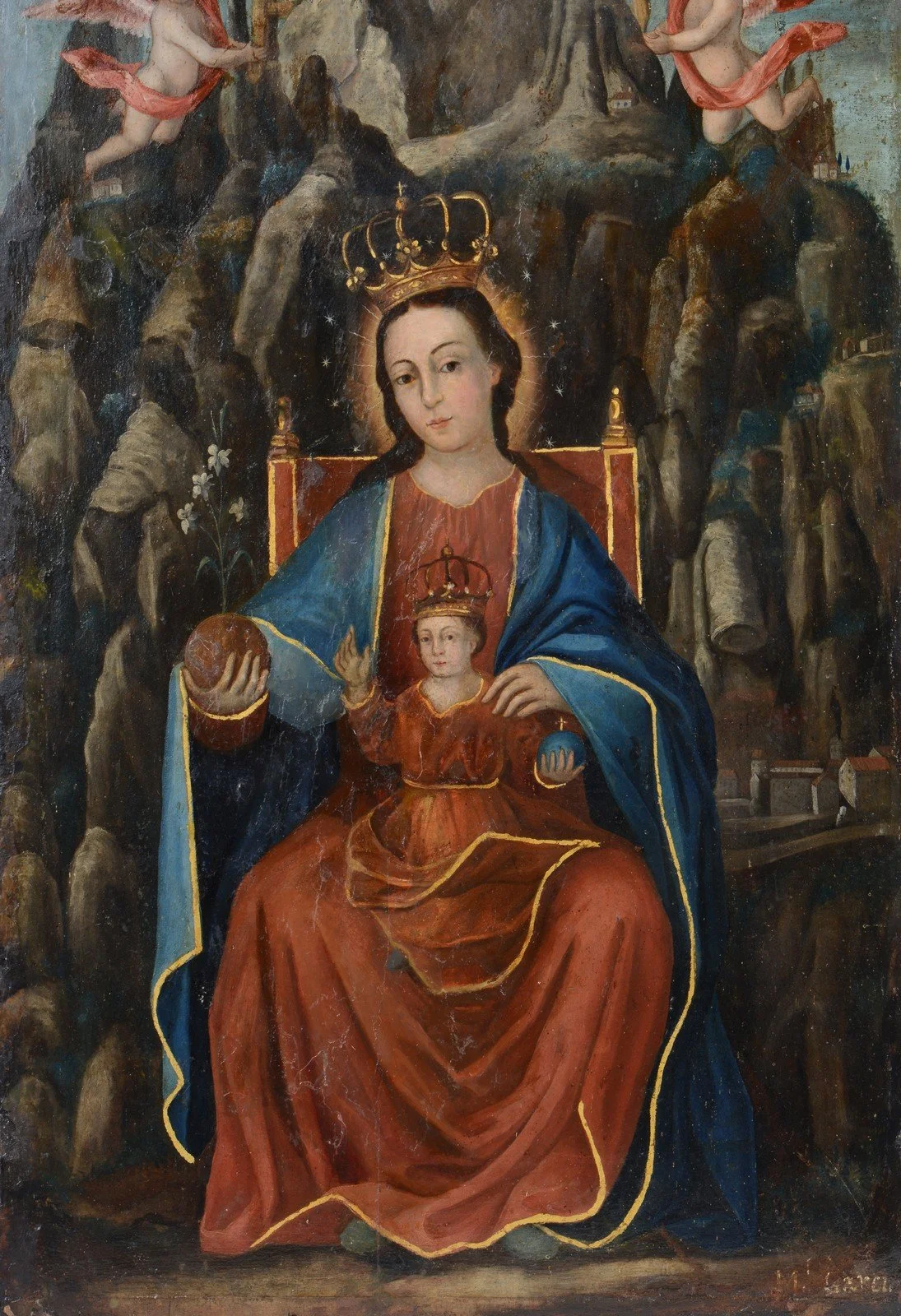
A sustained observation of the self, developed largely in silence over the course of two decades. The work draws particular inspiration from the imaginative force I associate with Manuel García’s Virgen de Monserrate, as well as from a personal desire to envision a Puerto Rican woman receiving a Nobel Prize.
García is often regarded as one of the earliest Puerto Rican painters to assert individual authorship through the signing of his work in the seventeenth century. That gesture, modest in appearance yet historically significant, invites broader reflection on the comparatively late emergence of an identifiable Puerto Rican artistic Renaissance. Rather than belonging to a single chronological moment, such a Renaissance might be understood as unfolding across several interconnected periods, geographies, and cultural circumstances—simultaneously situated in time, memory, and space.
•
Grace Matos
Independent Art Researcher
•
© [(1992)(2026)+(Present)x(Future)] Grace S. Matos García / Grace Portal/ graceportal.art | Writing and editing work held with care. All rights and lefts reserved.
•
Thank you for reading!
🤍
Resources
"The Bernadotte Library." The Royal Palaces, Swedish Royal Court, 13 Apr. 2018, www.kungligaslotten.se/english/articles-movies-360/the-royal-palace/2018-04-13-the-bernadotte-library.html.
Dennett, Daniel C. Breaking the Spell: Religion as a Natural Phenomenon. Viking, 2006.
Han, Byung-Chul. Saving Beauty. Translated by Daniel Steuer, Polity Press, 2017.
Heinlein, Robert A. Beyond This Horizon. Fantasy Press, 1948.
"History." National Library of Sweden, www.kb.se/eng/about-us/history.html. Accessed 11 Sept. 2026.
Nietzsche, Friedrich. On the Genealogy of Morality. Edited by Keith Ansell-Pearson, translated by Carol Diethe, Cambridge UP, 2006.
Nietzsche, Friedrich. The Birth of Tragedy. Translated by Walter Kaufmann, Vintage Books, 1967.
Ramachandran, V. S., and Sandra Blakeslee. Phantoms in the Brain: Probing the Mysteries of the Human Mind. William Morrow, 1998.
Stockton, Kathryn Bond. Gender(s). MIT Press, 2021.
"Virgen de Monserrate." Museo de Arte de Puerto Rico, www.mapr.org/en/art/artwork/virgen-de-monserrate.
Weinberg, Steven. To Explain the World: The Discovery of Modern Science. Harper, 2015.